 A baby puts everything in its mouth because its mouth is one of its most effective sensory organs. For adults, "seeing is believing", because we (or at least those of us who are sighted) get most of our information via our eyes. But what do we do when we want to observe something beyond our experience—something not accessible to the five external senses? We imagine, of course. But when that imagination is tempered by logic and care, it really becomes an eye on an internal world.
Physicists call it the Thought Experiment. Actually, since it was popularized by Albert Einstein, whose native tongue was German, it is usually referred to by its German name Gedankenexperiment, which literally translated is ..."thought experiment".
[Aside: I love the song "Die Gedanken Sind Frei", which I learned of from the Unitarian Universalist hymnal.]
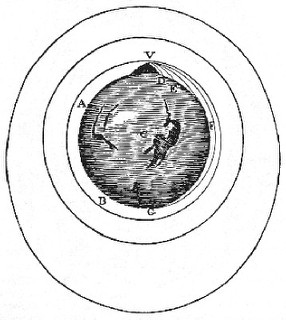
This diagram is due to one the most influential scientists in history, Sir Isaac Newton. (More about him and my little intersection with him later.) It is a diagram designed to explain how objects can be put into orbit. It was drawn more than 250 years before Sputnik, and nearly 100 years before the first balloon flight. It is still, in my opinion, the clearest way of explaining how satellites orbit.
A cannon sits atop a mountain, which by the looks of it is around 500 miles tall, which is about 100 times the height of Mt. Everest. It shoots cannonballs that fall back to the Earth in the usual parabolic path. Each successive cannonball is shot faster so that it goes farther than the last. Eventually, when a cannonball's trajectory curves more slowly than the orb of Earth, it falls forever without running into the Earth. In other words, it goes into orbit around the Earth.
The only way Newton could "see" this was in his mind. This thought experiment allowed Newton to extrapolate from the world of his everyday sense to things on the scale of the Earth or even the solar system. With this simple diagram, he showed how things orbit. The moon orbits the Earth because it falls, due to gravity, in a gentle curve around and around the Earth.
But it is important to look at a diagram like this with care. It is not enough to glance with your inner eye. You have to look carefully. Confession: When I looked at the diagram, I assumed that by fine tuning the speed of the cannonball, you could get it to hit anywhere around the Earth, say where the A or the B are. But they are not potential landing sites. I should have thought about it more. Then I came across this Java applet which lets you simulate the trajectory for any speed you wish. I soon realized that once the cannonball is fast enough to make it past the South pole, G, it would make it all the way around. You can't get it to hit near A or B (neglecting friction). Try it. Find the largest speed for which the cannonball still hits the Earth. Then see what happens 1 mile/hr more than that. Like many other physical situations, there is a symmetry that can tell you what is going on. If the cannonball can make to the South Pole, then it traces a path on the other side of the Earth that is a mirror image of the path it took getting there, and hits the cannon from behind. The whole path is an ellipse with the closest point at the South Pole.
[confidence level: established, my qualifications: trained]


